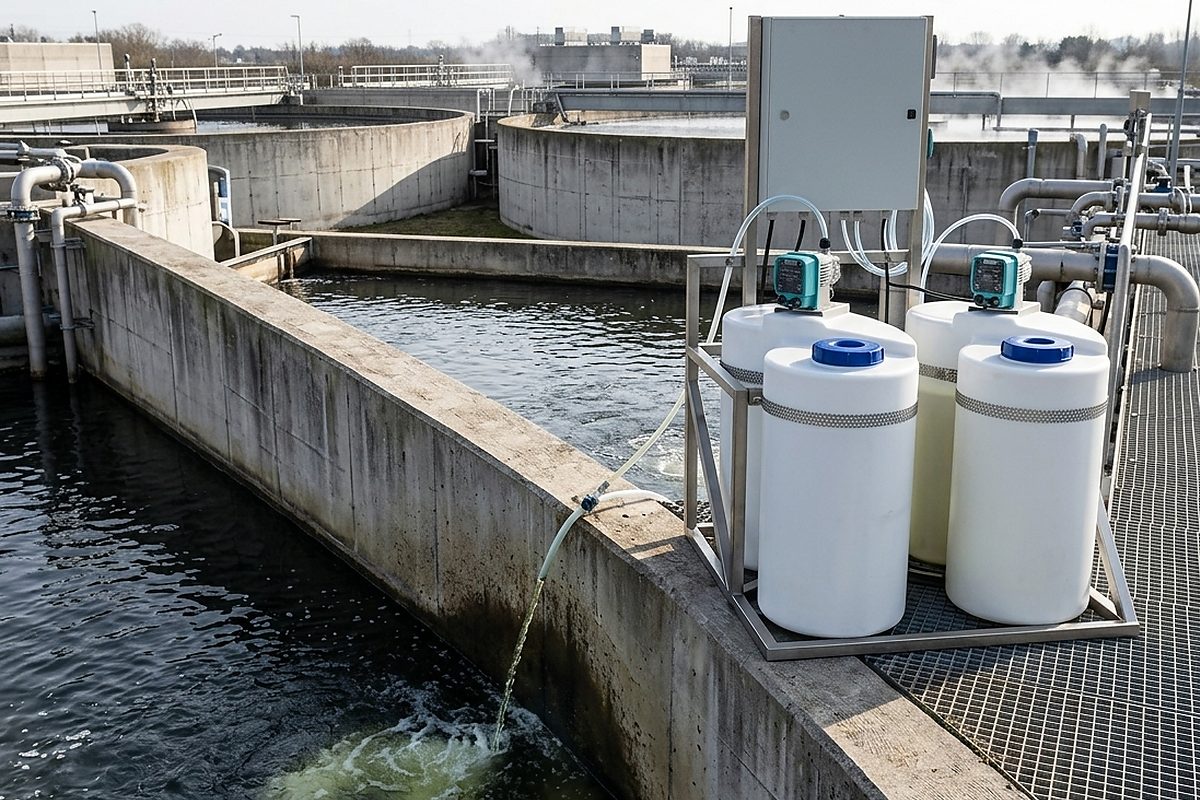
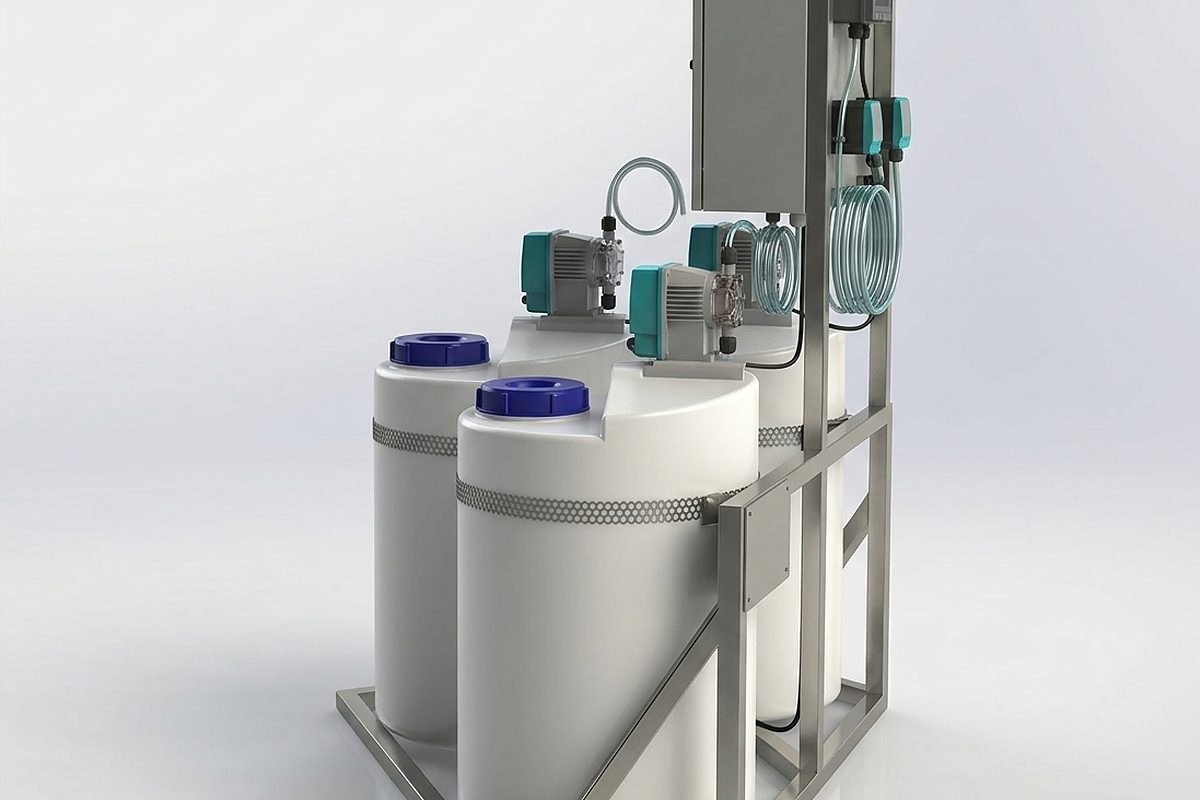
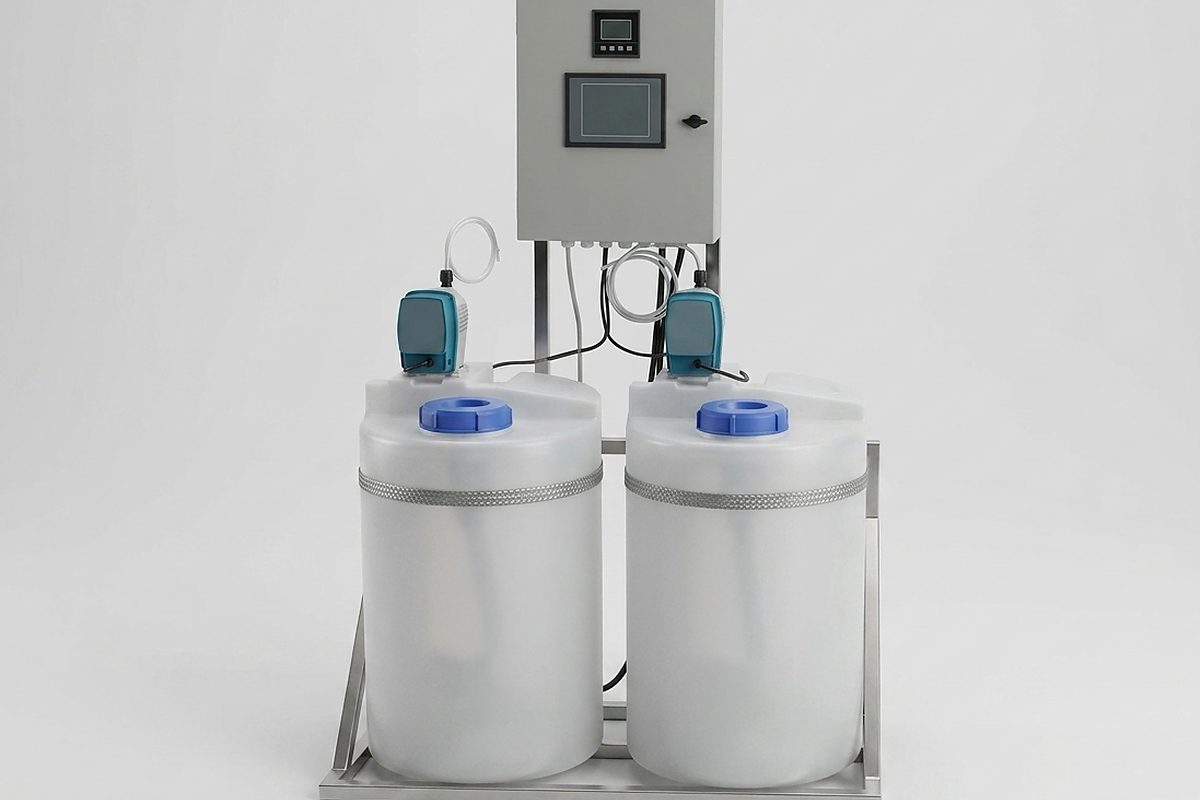
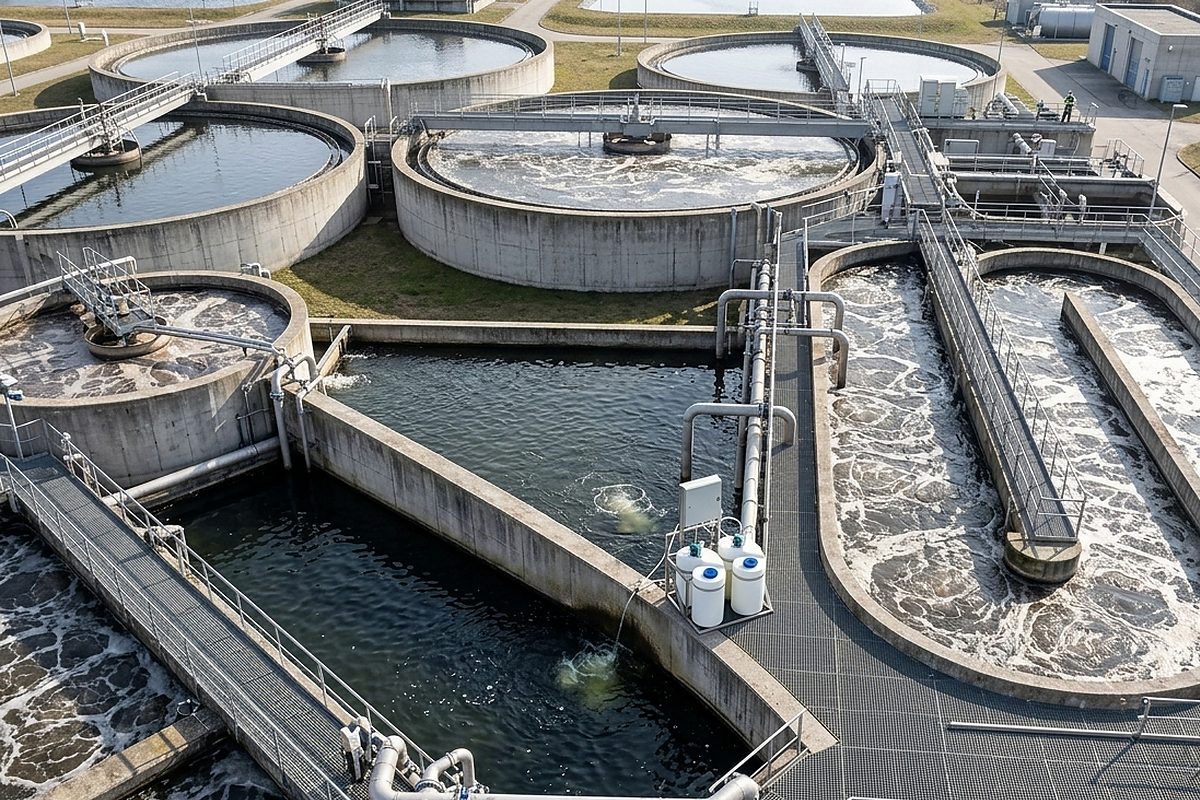
Some images are technical illustrations. Real installation photographs where marked.
Overview
The CG Smart Dosing System™ is an intelligent PLC-controlled chemical dosing platform that continuously monitors water quality using inline sensors and automatically adjusts dosage rates to maintain target treatment conditions in real time. Unlike fixed-rate dosing systems that apply constant chemical doses regardless of actual variation — resulting in overdosing (wasted cost and environmental risk) or underdosing (treatment failure) — the CG Smart Dosing System uses closed-loop control algorithms matching dosage precisely to instantaneous process requirements. Applicable to coagulation/flocculation, pH adjustment, disinfection, scale inhibition, and nutrient dosing in plants of all sizes, it delivers 20–40% reductions in chemical consumption.
Working Principle
Inline water quality sensors measure process parameters continuously: pH, ORP, turbidity, or online chlorine analyser, depending on the application. Sensor signals are transmitted in real time to the PLC controller. The PLC executes a PID control loop comparing the measured value with the target setpoint and calculates the required dosing rate. The dosing pump output is modulated (via 4–20 mA or PWM control) to match the calculated requirement. If the process parameter deviates due to a load change, the controller responds within seconds, adjusting pump output to compensate. All readings, pump outputs, and alarm events are logged for trend analysis and regulatory reporting.
Key Technical Features
- PLC closed-loop control — real-time dosage adjustment
- Inline sensors: pH, ORP, turbidity, residual Cl₂, conductivity
- Dosing pumps: peristaltic (0.1–100 L/hr) or diaphragm (1–1,000 L/hr)
- Up to 8 independent dosing channels
- Flow-proportional dosing mode available
- PID control — fast response to load changes
- Data logging: readings, pump output, alarms — 1-min intervals
- Remote monitoring via SCADA, Modbus, or 4G/cloud
- Chemical containment bund and leak detection standard
- Reduces chemical consumption 20–40%
- Metering accuracy: ±1%
Design Parameters
| Parameter | Value |
|---|---|
| Sensors | pH/ORP/Turb./Cl₂ |
| Pump Type | Peristaltic/Diaphragm |
| Pump Range | 0.1–1,000 L/hr/channel |
| Dosing Channels | 1–8 |
| Control | PID Closed-Loop PLC |
| Communication | Modbus/4–20mA/4G |
| Chemical Saving | 20–40% |
Applications
- Coagulant dosing for DAF/SAF systems (turbidity feedback)
- pH adjustment for industrial ETP
- Chlorine disinfection (residual feedback)
- Lime or acid dosing for pH neutralisation
- Anti-scale dosing for cooling towers
- Polymer dosing for sludge dewatering
- Nutrient dosing for biological systems
Advantages
- Eliminates manual dosing — reduces human error
- 20–40% chemical cost saving
- Prevents overdosing — reduces chemical discharge
- Prevents underdosing — ensures consistent compliance
- Real-time logging supports EPA regulatory reporting
- Remote monitoring enables rapid response to upsets
- Scalable — additional dosing channels added easily
Frequently Asked Questions
Request Technical Proposal for CG Smart Dosing System™
Share your project details — our engineers will respond within 48 hours.