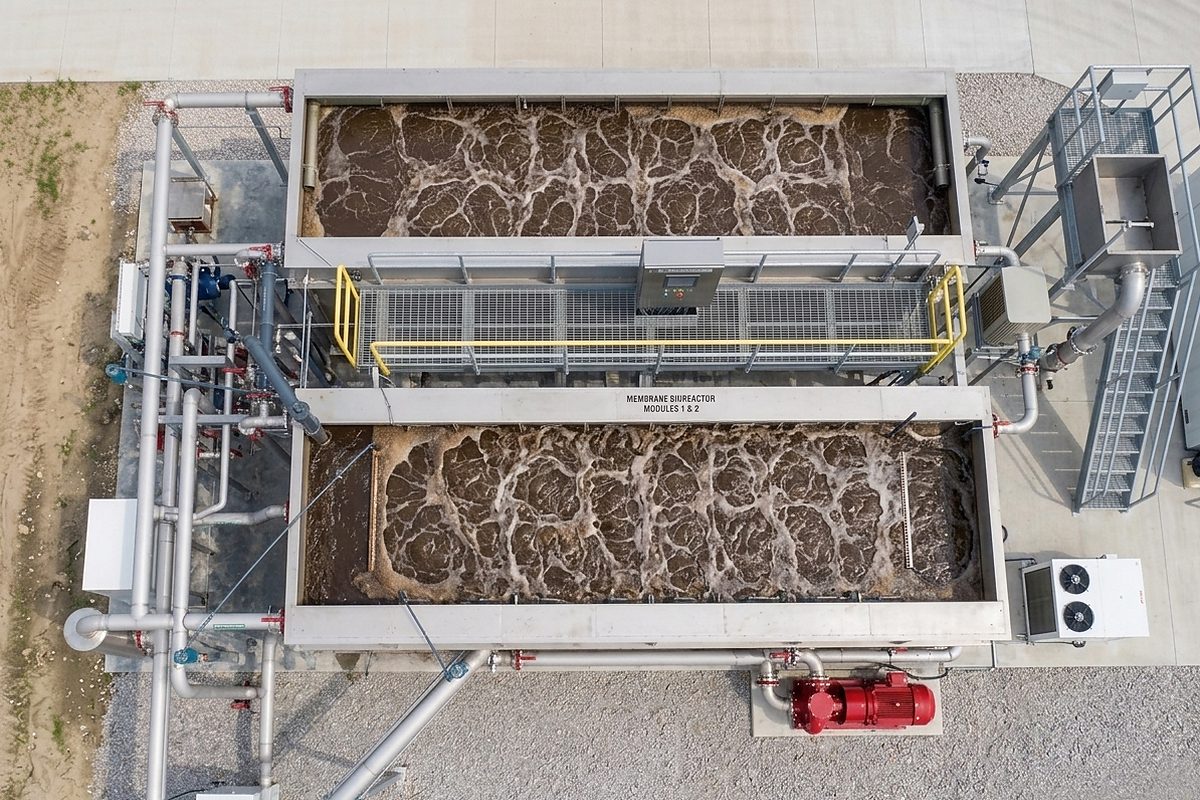
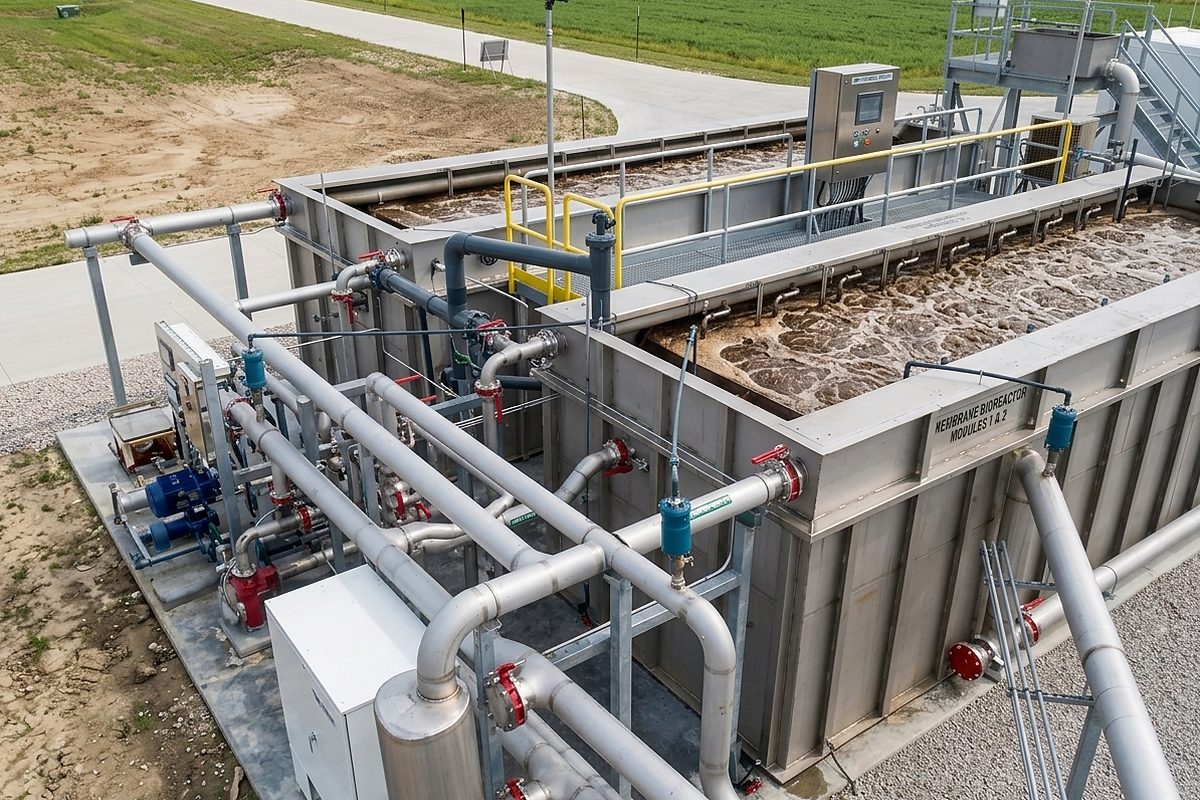
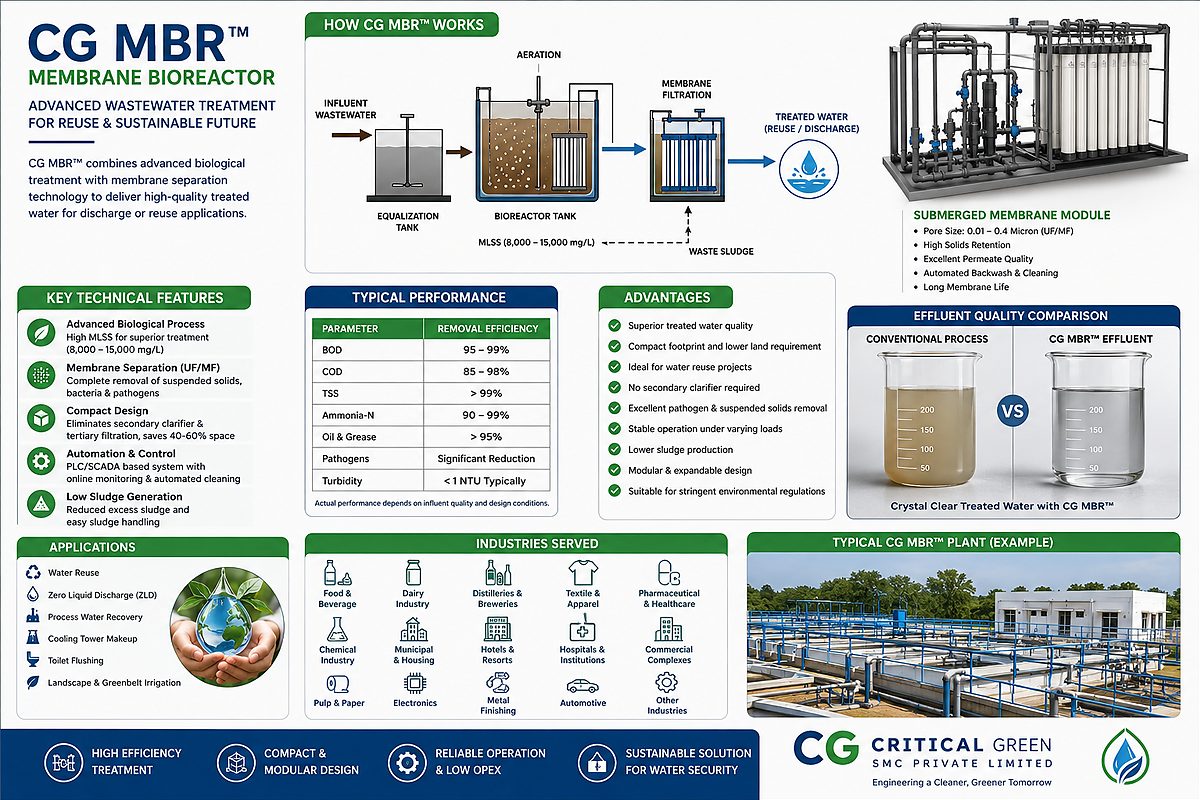
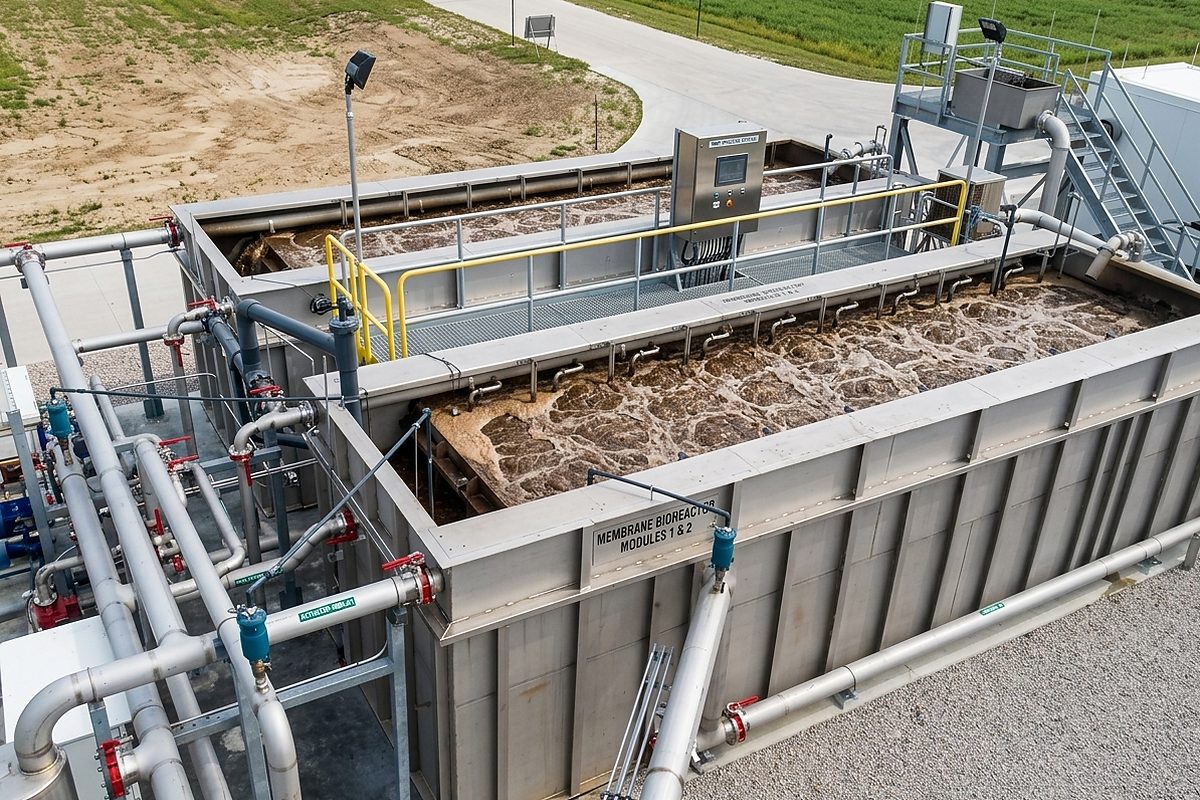
Some images are technical illustrations. Real installation photographs where marked.
Overview
The CG MBR™ (Membrane Bioreactor) integrates conventional activated sludge biological treatment with submerged ultrafiltration membrane separation into a single compact system. By eliminating the secondary clarifier and replacing it with a membrane barrier — with pore sizes of 0.04–0.4 μm — the MBR consistently produces treated effluent of exceptionally high quality: BOD <5 mg/L, SS essentially zero, and turbidity <1 NTU. This effluent quality is suitable for direct landscape irrigation, toilet flushing, industrial process reuse, and, after UV disinfection, for unrestricted reuse. The ability to operate at very high mixed liquor suspended solids (MLSS) concentrations of 8,000–15,000 mg/L — compared to 3,000–4,000 mg/L in conventional plants — means the biological reactor volume required is dramatically smaller, making MBR the most compact biological treatment technology available. CG MBR systems are the preferred choice for DHA housing projects, underground installations, hotels, hospitals, and pharmaceutical facilities where space is limited and effluent quality demands are highest.
How It Works — Working Principle
Wastewater enters the biological aeration tank after primary screening. Air is supplied to the mixed liquor both for biological oxidation of BOD and COD, and for continuous membrane scouring to prevent fouling. Inside the membrane tank, submerged hollow-fibre or flat-sheet ultrafiltration modules are immersed in the mixed liquor. A slight vacuum (0.1–0.5 bar) is applied to draw treated water through the membrane pores, retaining all suspended solids, bacteria, and most protozoa and viruses within the system. Concentrated sludge remains in the reactor at high MLSS (8,000–15,000 mg/L), providing long sludge retention times (SRT 15–30 days) that enhance degradation of complex organics. Periodically, the membranes are backwashed with permeate and subjected to chemical enhanced backwash (CEB) using sodium hypochlorite or citric acid to remove fouling. Excess biological sludge is wasted periodically to maintain target MLSS.
Key Technical Features
- Effluent BOD: <5 mg/L (consistently)
- Effluent SS: ~0 mg/L (membrane as absolute barrier)
- Effluent turbidity: <1 NTU
- Pathogen removal: >6 log reduction (viruses, bacteria, protozoa)
- Operates at MLSS 8,000–15,000 mg/L — biological tank 3× smaller than conventional
- No secondary clarifier — 30–40% smaller overall footprint
- Hollow-fibre or flat-sheet membrane configurations
- Pore size: 0.04–0.4 μm (ultrafiltration)
- Automated backwash and CEB (chemical enhanced backwash) cycles
- SRT 15–30 days — enhanced sludge stabilisation
- Low sludge production
- PLC/SCADA control with remote monitoring via GSM/4G
- Suitable for underground and concealed installation
- Effluent suitable for direct reuse without further clarification
Typical Design Parameters
| Parameter | Range / Value |
|---|---|
| Flow Range | 20–5,000 m³/day |
| Effluent BOD | <5 mg/L |
| Effluent SS | ~0 mg/L |
| Effluent Turbidity | <1 NTU |
| MLSS | 8,000–15,000 mg/L |
| SRT | 15–30 days |
| HRT (membrane) | 0.5–2 hours |
| Membrane Pore Size | 0.04–0.4 μm |
| Backwash Cycle | Every 8–15 min |
| CEB Frequency | Weekly/Monthly |
| Pathogen Removal | >6 log |
Applications
- Sewage treatment for housing societies and gated communities (DHA, LDA)
- Hotel, resort, and hospital sewage treatment with reuse
- Pharmaceutical manufacturing wastewater
- Food and beverage effluent with reuse requirement
- Underground STP — below green areas or car parks
- Containerised and mobile treatment units
- High-quality effluent for irrigation reuse
- Effluent polishing after existing biological treatment
- Commercial plaza and office complex sewage
- Airport and large institutional facilities
Advantages
- Smallest footprint of any biological treatment technology
- Consistent high-quality effluent regardless of inlet variation
- No secondary clarifier — eliminates a major capital cost item
- Suitable for direct water reuse — irrigation, toilet flushing
- Long SRT produces well-stabilised sludge
- Low sludge production reduces dewatering costs
- Modular membrane design — capacity easily expanded
- Ideal for underground concealed installations
- Fully automated — minimal operator attendance
- Complies with most stringent provincial EPA reuse guidelines
Frequently Asked Questions
Request Technical Proposal
Share your project details and our engineers will prepare a tailored technical and commercial proposal within 48 hours.