
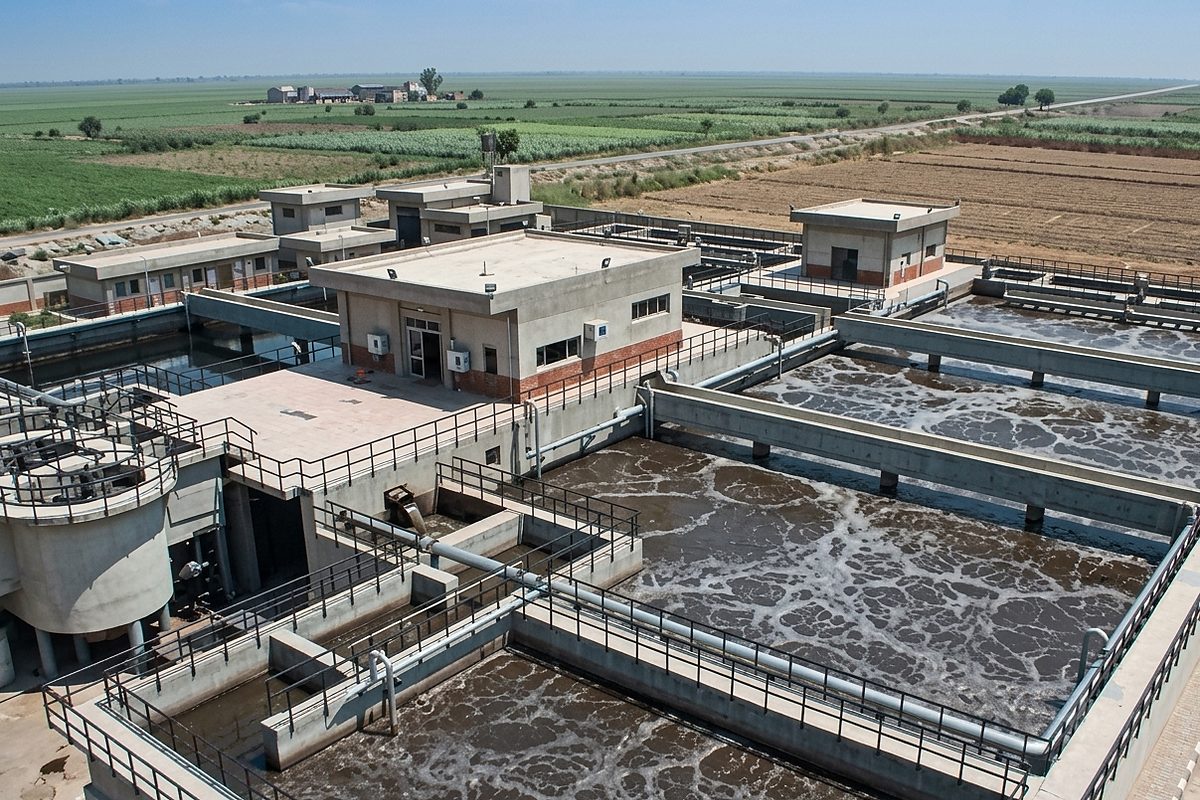
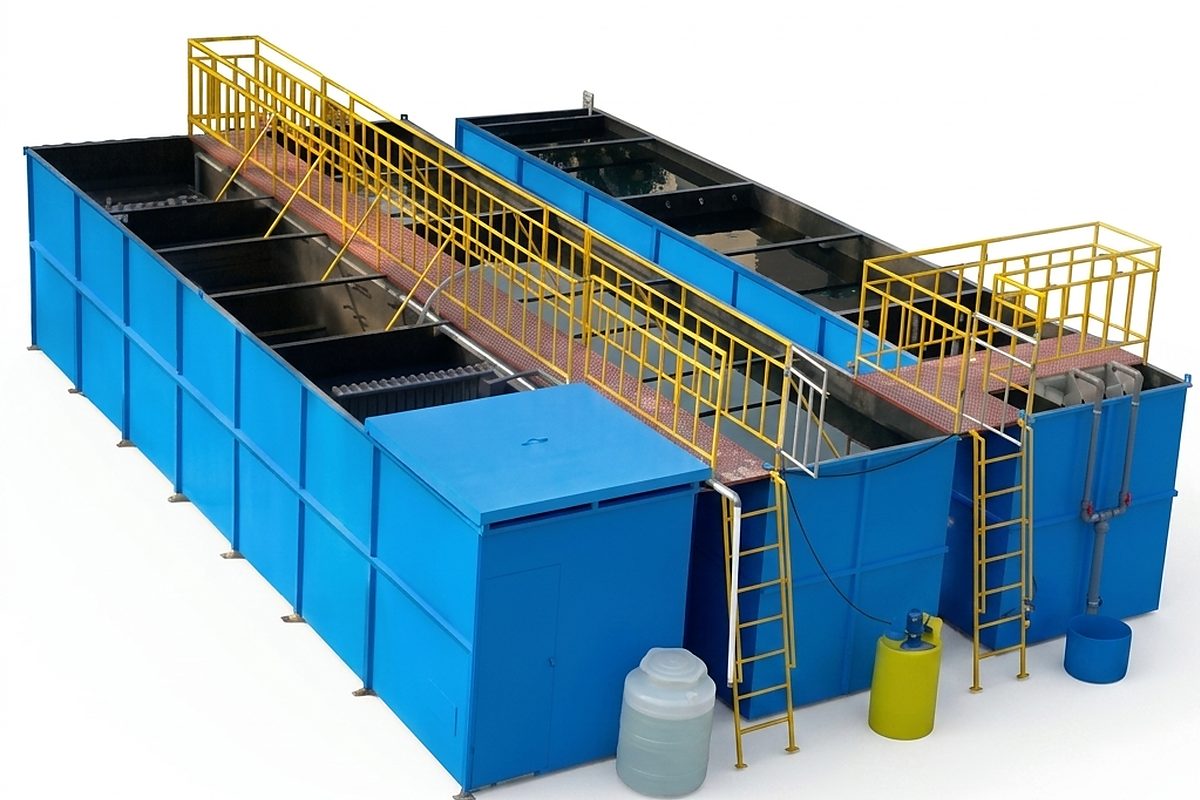
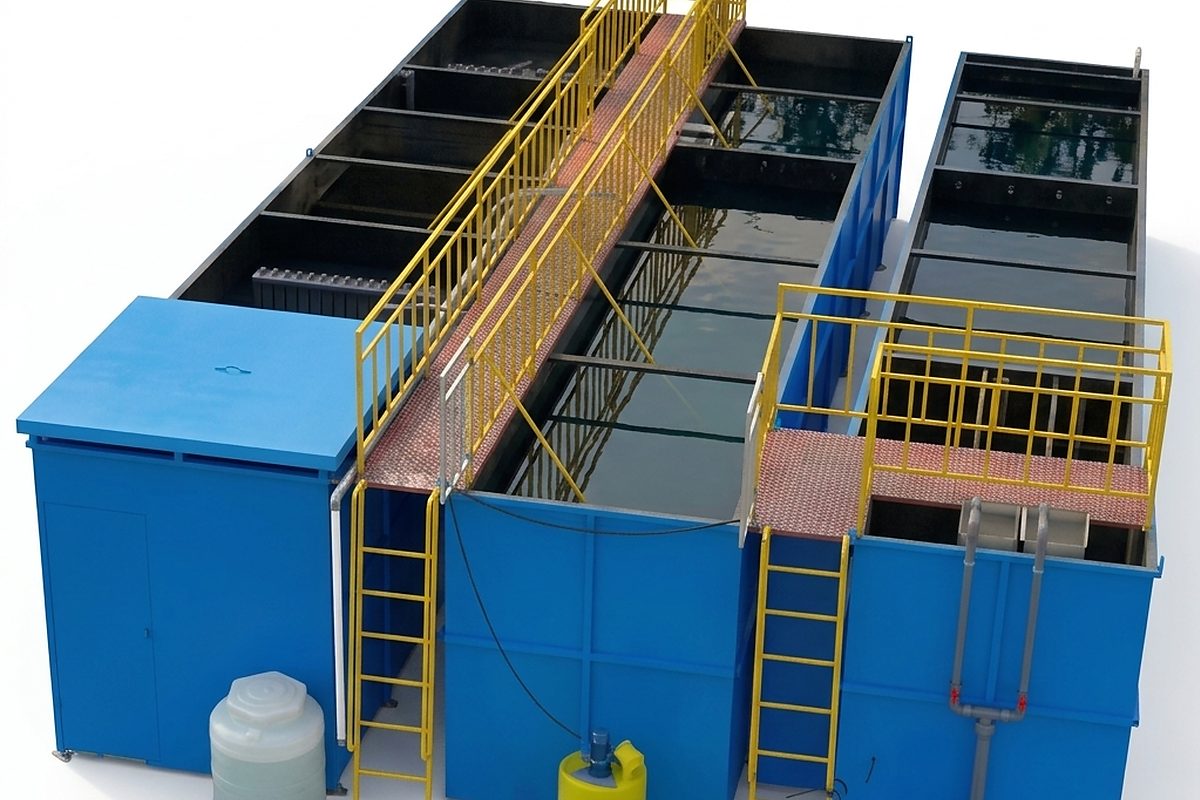

Some images are technical illustrations. Real installation photographs where marked.
Overview
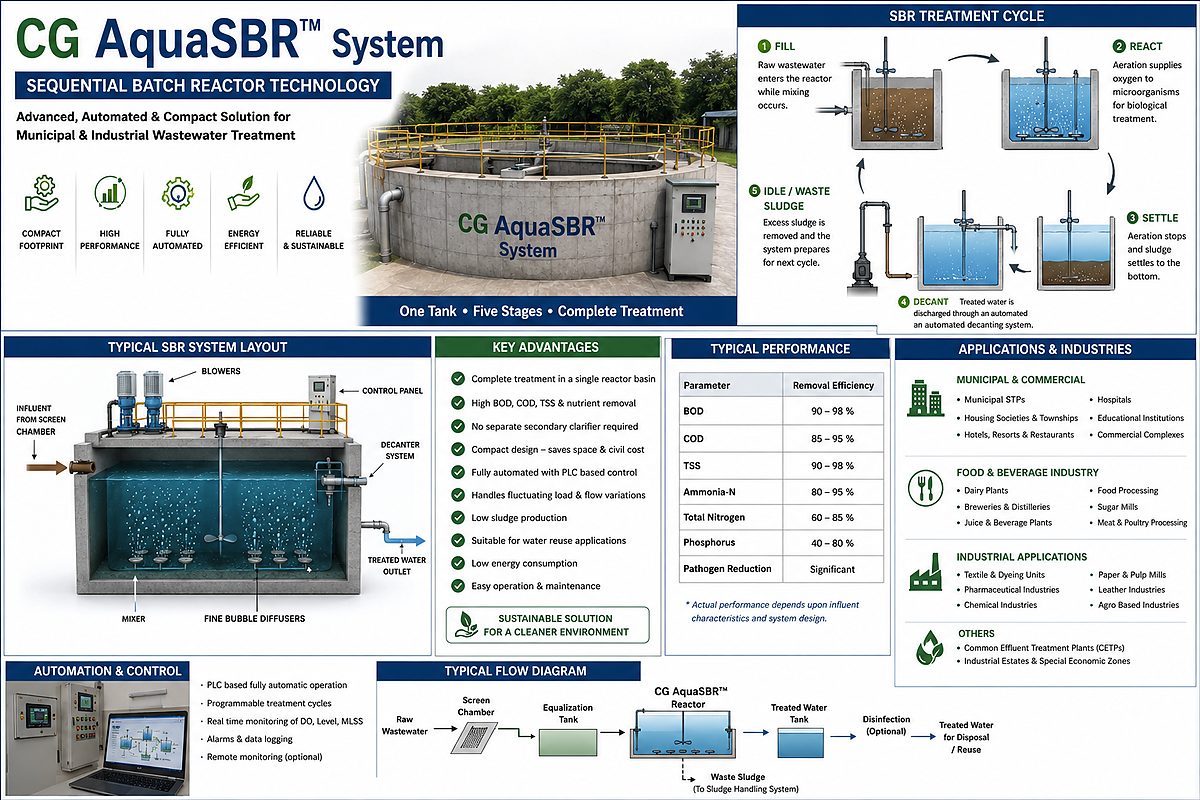
The CG AquaSBR™ (Sequential Batch Reactor) is a fill-and-draw activated sludge system in which all biological treatment phases — aeration, settling, and decanting — occur sequentially within a single reactor tank. This eliminates the need for separate secondary clarifiers, return activated sludge (RAS) pumps, and recirculation lines that conventional continuous-flow activated sludge systems require. Operating in automated cycles of Fill → React (aerate) → Settle → Decant → Idle, the SBR delivers excellent and consistent effluent quality for biological oxygen demand (BOD) removal, nitrification of ammonia, and simultaneous or post-anoxic denitrification. The CG AquaSBR™ incorporates a floating decanter that follows the water surface during decanting, preventing disturbance of the settled sludge. PLC automation manages cycle timing, aeration intensity, and decant level, adapting to varying inflow conditions.
How It Works — Working Principle
The SBR cycle begins with the Fill phase where raw or pre-treated wastewater is admitted to the reactor tank. In the React phase, surface aerators or fine-bubble diffusers activate and supply oxygen for biological oxidation. Nitrification of ammonia occurs during aerated react periods; denitrification can occur in anoxic react periods where mixing continues without aeration. When biological treatment is complete, aeration stops and the Settle phase begins — with no inflow or outflow, the sludge settles to the tank floor undisturbed, producing a very clear supernatant. In the Decant phase, a floating decanter assembly slowly draws treated water from just below the surface down to the minimum liquid level, removing effluent without disturbing the settled sludge. The cycle then repeats. For continuous flows, two or more SBR tanks are operated in parallel, alternating cycles to accept continuous inflow.
Key Technical Features
- No secondary clarifier — settling occurs in the same tank
- No RAS pump — activated sludge never leaves the reactor
- BOD removal: >90% (effluent BOD typically <20 mg/L)
- Nitrification: NH₃-N removal >85%
- Denitrification available (anoxic react phase)
- PLC-controlled automated cycle management — 24/7 operation
- Floating decanter — follows surface level, preserves settled sludge
- Cycle time: 4–8 hours (adjustable)
- 2–4 tanks for continuous flow applications
- MLSS: 3,000–5,000 mg/L
- SRT: 10–30 days
- Aeration: fine-bubble diffusers or surface aerators
- Compact footprint vs conventional activated sludge
- Tolerates daily and seasonal load fluctuations well
- Easy to expand by adding additional SBR tanks
Typical Design Parameters
| Parameter | Range / Value |
|---|---|
| Flow Range | 50–10,000 m³/day |
| Inlet BOD | 100–2,000 mg/L |
| BOD Removal | >90% |
| Effluent BOD | <20 mg/L |
| NH₃-N Removal | >85% |
| Cycle Time | 4–8 hours |
| MLSS | 3,000–5,000 mg/L |
| SRT | 10–30 days |
| HRT | 8–24 hours |
| Control | PLC Automated |
Applications
- Industrial ETP secondary treatment after DAF primary stage (textile, edible oil)
- Municipal sewage treatment for towns and housing societies
- Hotel, hospital, and institutional sewage treatment
- Post-UASB aerobic polishing for sugar mill and food industry
- Pharmaceutical manufacturing wastewater treatment
- Airport and large commercial facility sewage
- Pre-treatment before reuse (paired with MF/UF membrane polishing)
- Upgrade of existing overloaded conventional activated sludge plants
Advantages
- No secondary clarifier — significant capital cost saving
- No RAS pump — lower energy and maintenance
- Flexible operation — cycle timing adjusted to actual flow
- Excellent settling due to undisturbed quiescent settle phase
- Single structure performs multiple functions — simpler design
- Proven technology with very large global installed base
- Suitable for flows from 50 to 10,000+ m³/day
- Easily automated — minimal operator skill required
- Can achieve nitrification and denitrification in one tank
- Lower footprint than conventional CAS (continuous activated sludge)
Frequently Asked Questions
Request Technical Proposal
Share your project details and our engineers will prepare a tailored technical and commercial proposal within 48 hours.